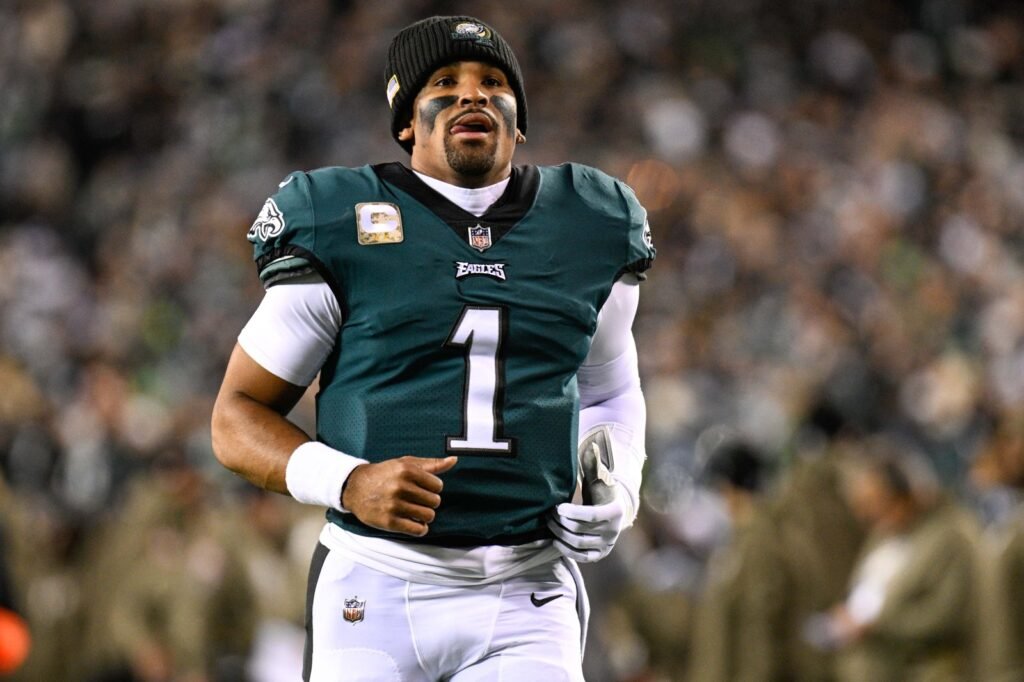
File photo, Jalen Hurts at Lincoln Financial Field on November 14, 2022. Credit: Photo by All-Pro Reels, via Wikimedia Commons, CC BY-SA 2.0
He played in London a day after a scan found a clot in his calf. The full diagnosis came from his agent, not the team, and the league says there will be no investigation.
Start with the man, because he matters more than the argument. Jalen Hurts is in stable condition, his prognosis is very good, and a full recovery is expected, his agent, Nicole Lynn, said in a statement on October 19, according to USA Today. “Jalen’s prognosis is very good, and we expect a full recovery,” Lynn wrote, according to USA Today on October 19. Nobody in Philadelphia should lose sight of that. But the way the Philadelphia Eagles handled the two weeks that led here deserves harder questions than it has gotten, and so far the team has answered almost none of them.
Read the timeline slowly, because the timeline is the story. Hurts hurt his calf against the Los Angeles Rams on October 4, stepped on by another player’s cleat, according to the Eagles, as reported by CNN on October 20. An ultrasound on October 10 found a blood clot, according to Reuters on October 17. The next day, October 11, he played a full NFL game in London against Jacksonville, completing 21 of 40 passes for 220 yards and one touchdown in a 19 to 17 loss, according to Reuters. A follow up ultrasound on Wednesday showed the clot moving, according to Reuters. On Saturday, October 17, the Eagles placed him on injured reserve, giving the reason as a superficial blood clot in his left calf, according to Reuters. On Monday, October 19, the public learned the fuller picture from his agent: the diagnosis was now deep vein thrombosis with bilateral pulmonary emboli, blood clots in both lungs, according to USA Today on October 19.
Somewhere in that timeline sits the decision this story turns on. A quarterback with a known blood clot was cleared to fly to London and play professional football one day after the clot was found. The general medical context, from experts who spoke to CNN on October 20 and who were not describing Hurts’ personal record, explains why that clearance matters: a pulmonary embolism happens when a clot breaks off and travels through the bloodstream to the lungs, and bilateral pulmonary emboli mean clots are blocking arteries in both lungs, according to CNN. Days after he played, a scan showed his clot moving. Philly Rhino is not a medical practice, and this article makes no claim about what his doctors knew on October 10. But readers do not need a medical degree to ask the obvious questions. What was the clearance based on, and who signed off on it?
The disclosure raises its own questions. When the team announced injured reserve on October 17, the stated reason was a superficial clot in his calf. The diagnosis of clots in both lungs reached the public two days later, in a statement from his agent, not from the team that employs him and cleared him. There may be innocent explanations, privacy rules, changing scans, careful wording. The Eagles have offered none of them in the sources reporting this story. The same pattern holds on the biggest football question: ESPN’s Adam Schefter reported that Hurts will miss the rest of the season, according to USA Today on October 19, and that remains reporting, not a team announcement. On the record, the Eagles have still only committed to injured reserve and at least four games missed.
Asked about it on Monday, October 19, head coach Nick Sirianni said he trusted the Eagles’ medical staff and their decision making when it came to clearing Hurts for the London game and for the flight back, according to USA Today on October 19. Trust is a fine thing inside a building. It is not an explanation, and it does not answer a single one of the timeline questions. Nobody is asking Sirianni to practice medicine. Asking what process cleared a franchise quarterback to play with a known clot, one day after it was found, is a football operations question, and it belongs to the organization, not to the doctors alone.
The league moved faster to close the story than the team has moved to explain it. On Tuesday, October 20, the NFL said it has been in contact with the Eagles throughout the treatment, and noted that Hurts was treated at the Cleveland Clinic in London, according to USA Today on October 20. League spokesman Brian McCarthy said the Eagles will not be investigated or punished for their handling of Hurts’ treatment, according to USA Today on October 20. That ruling arrived one day after the full diagnosis became public, and before the team had explained the clearance in any detail. USA Today also reported on October 20 that it reached out to the NFL Players Association for comment, with no response reported in that article. So the league has closed its file, the union has said nothing in the reporting so far, and the central question sits exactly where it started.
The football cost lands on a team that was already sliding. Injured reserve means at least four games missed, against the Carolina Panthers, the Dallas Cowboys, the Washington Commanders, and the New York Giants, according to Reuters on October 17. Philadelphia was 2 and 3 and had lost three straight when the move was made, with a Week 10 bye set aside for reevaluation, per ESPN and NFL Network reporting cited by Reuters. Whether that reevaluation plan still stands after the October 19 diagnosis has not been confirmed. In five games, Hurts threw for 933 yards and eight touchdowns, with three interceptions, according to Reuters. Tanner McKee started against Carolina and went 26 of 45 for 215 yards and a touchdown, according to USA Today on October 19, with rookie Cole Payton as backup and Joe Milton signed off the Dallas practice squad, according to Reuters.
Why he cannot simply play through treatment is the one part of this story that is fully explained. His treatment is blood thinners, and he cannot take part in contact activities while on them, according to USA Today on October 19. Experts told CNN on October 20 that people on blood thinners face a high risk of bleeding in contact sports, and that blood thinner treatment commonly runs three to six months, because that is roughly the time the body needs to dissolve a clot. That range is general medical information from CNN, not a confirmed timeline for Hurts, and no exact return date has been given for him.
What would settle this is not complicated. The Eagles can explain what the London diagnosis was, when it changed, what the clearance to play and to fly was based on, and who made the final call. They can say whether the Week 10 reevaluation is still the plan. Until they do, Philadelphia is left with a timeline that speaks for itself: a scan on Saturday, a game in London on Sunday, a moving clot by Wednesday, season ending news reported by a national insider, and the full diagnosis delivered by an agent on Monday. The most important person in the franchise deserved a clearer process than that, and the fans who fund the whole operation deserve clearer answers than they have gotten.