
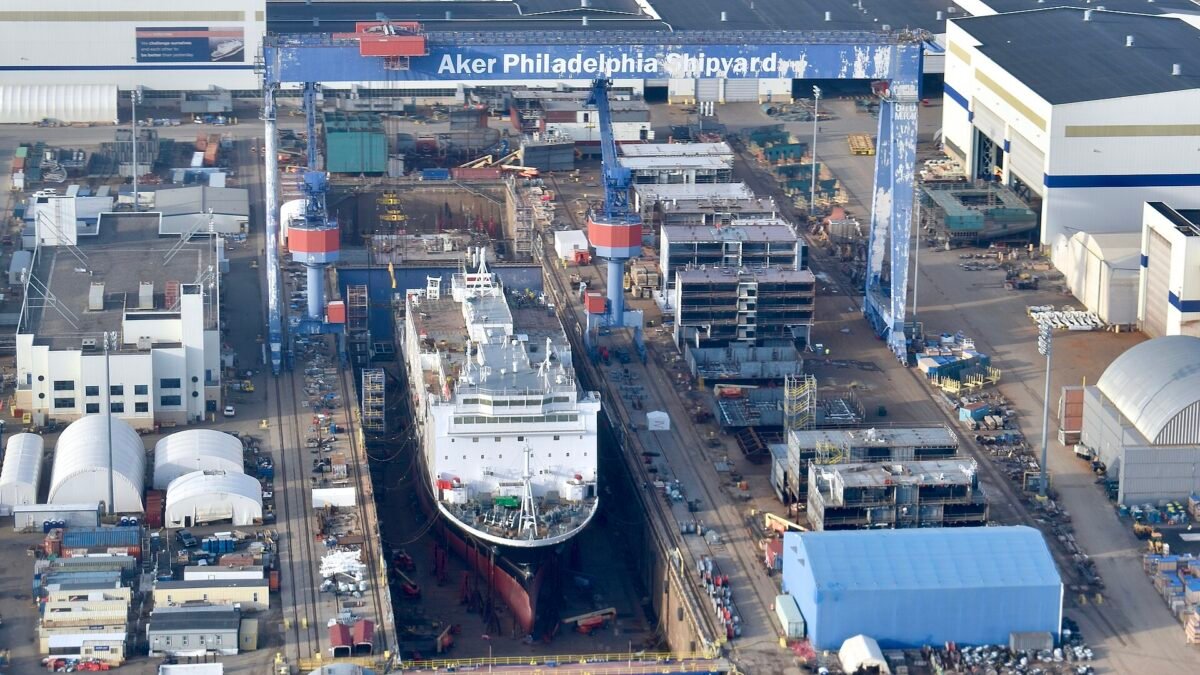
The first sparks flew Tuesday at Hanwha Philly Shipyard, and with them the promise of years of work in South Philadelphia.
The yard cut steel on the first of four medium range oil and chemical tankers ordered by Hanwha Shipping, starting a construction program that runs through 2030. Each ship will carry about 49,500 deadweight tons of crude oil, refined petroleum products, and chemicals, and all four are scheduled for delivery in 2029 and 2030.
The ships will be built in the United States and designed to comply with the Jones Act, the law that requires vessels moving cargo between American ports to be American built, owned, and crewed. They will have an energy efficient design and meet international standards for carrying chemical cargoes, with an optional configuration that keeps 18 different cargoes separate in transit.
The program matters because the domestic tanker fleet is old, and nobody in the United States has built a tanker of this type in nearly a decade. That is the company’s own description, and it is the point Hanwha keeps coming back to: the country stopped building these ships, and Philadelphia is where they are coming back.
“These vessels represent an investment in America’s maritime future, energy security, and industrial capability,” said James Sagar, CEO of Hanwha Shipping. “They will join the Jones Act fleet to transport the fuels that power American homes, businesses, and communities safely and efficiently.”
For the yard, the tankers are the foundation of steady work. “Today’s steel-cutting ceremony represents an important step forward for Hanwha Philly Shipyard and our workforce,” said Hyuk Kim, the shipyard’s president. “A strong shipbuilding industry depends on consistent production, skilled people, and the ability to deliver quality vessels to our customers. This four vessel program provides an important foundation for that work, and our focus now is on executing safely, efficiently, and successfully.”
The tankers are not the only work in the yard. On October 30, TOTE Services picked Hanwha Defense USA to build the first Medium Landing Ship for the U.S. Navy and Marine Corps, a $269 million contract for one ship with options for three more. It is Hanwha’s first Navy shipbuilding award since it bought the yard in December 2024. Construction starts in late 2027, with delivery expected in 2030. The landing ship is part of a Navy plan for a 35 ship fleet of smaller amphibious vessels, built under a $2.2 billion vessel construction manager contract that TOTE runs.
The Navy work started earlier. In March, Hanwha won its first Navy project as a subcontractor, helping design the Next Generation Logistics Ship, a smaller vessel built to refuel, resupply, and rearm combat ships. The yard has also finished the contract for a Missile Range Instrumentation Vessel, with the first delivery due in 2030. The yard has already built and delivered four National Security Multi-Mission Vessels, the training ships for the state maritime academies.
All of it adds up to the pipeline behind the number from last week’s story: the yard is going from fewer than two ships a year to as many as 20, backed by a $2 billion White House investment, with 7,000-plus jobs expected over five years, most starting above $20 an hour. Hanwha has announced a $5 billion investment plan for the yard, and says it already has orders for 10 medium range tankers and two LNG carriers.
But the pipeline only pays off if Philadelphia can supply the workers. Only about a quarter of district high schoolers scored proficient on state math last year, and only 4 of about 55 district high schools offer welding. The ships are coming. The question, the same one from last week, is whether the city’s schools and training programs can produce the welders, machinists, and electricians to build them.
For now, the yard that spent years shrinking is building commercial tankers and Navy ships at the same time, and Tuesday was the day the work started getting real.