
More than 7,000 good jobs are coming to Philadelphia’s shipyard, most starting at more than $20 an hour. The catch is that the city’s own high school students mostly can’t get through the door, because the math they need was never taught to them.
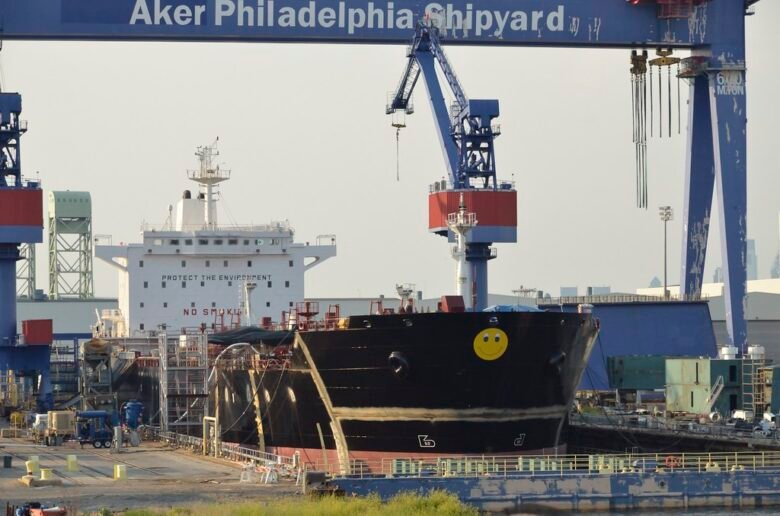
Hanwha Philly Shipyard plans to go from building fewer than two ships a year to as many as 20, backed by a $2 billion White House investment, adding more than 7,000 jobs over five years. Most start above $20 an hour, nearly three times the state minimum wage of $7.25.
These are the jobs politicians love to talk about: good pay, on the job training, no college debt, work AI can’t do. But in Philadelphia’s public schools, the pipeline to those jobs is barely built, and the math gap underneath it is wide.
Only about a quarter of district high school students scored proficient on the state math test last year. Only four of the district’s roughly 55 high schools even offer welding. Last school year, only about half of the seniors in the district’s construction and manufacturing training programs scored competent or advanced on the NOCTI, the state test for career and technical students.
The gap shows up in the classroom every day. At Ben Franklin High School, retired ironworker Harry Graham runs welding classes three periods a day, 24 students sharing 16 practice booths. Some students join his program in 10th grade unable to add fractions. Others are still learning to read a ruler. Most rely on calculators, which won’t help them on trade union tests.
Down the hall, Adam Ring teaches the district’s only precision machining program, working with several $50,000 CNC machines. He said he spends much of his class time teaching students math, even basic addition.
“It’s all technical language and jargon,” Ring said. “Tons of machining jobs are related to college-level skills.”
That is the part the sales pitch leaves out. These jobs get sold as the option for kids who aren’t on a college track, but the work demands college level math the district is not delivering.
Kristopher Purnell, 17, an 11th grader at Ben Franklin, wants to be an underwater welder, a job that can pay more than $100,000 a year by 25 for those who move quickly through certification. He has already been arc flashed, a severe sunburn on the cornea from a helmet worn wrong, and picked up minor burns along the way. He is not put off.
“What motivates me, I gotta say, it’s the pay stub,” Purnell said.
Not everyone stays. Aahayla Capers, 17, trained in welding for almost three years at Ben Franklin before deciding the physical toll and tight quarters weren’t for her.
“I couldn’t take it up as a full career,” she said. She plans to join the military after graduation.
The barriers go beyond math. Shipbuilding is still mostly male, its jobs have historically come through family connections, and Philly’s trade unions carry a history of racism against Black workers. Graham, who is Black, said he tries to help the city’s mostly Black and Latino students see a place in the trades, and more young women have joined his program in recent years.
The city is working with the district to expand middle school programs that introduce the trades to 12 and 13 year olds. The Community College of Philadelphia runs advanced manufacturing programs that are often free, with funding from the U.S. Navy. Rhoads Industries, which builds submarines, offers apprentices a starting salary of $25 an hour.
But the seats are limited, and the need is not. Ron Sizer, who runs the advanced manufacturing program at the Community College of Philadelphia, put it plainly.
“I have more job opportunities than seats,” Sizer said. “We’re just trying to do more to fill that gap.”
The jobs are real, and the pay is real. What is not real yet is a school system that prepares Philadelphia’s kids to take them. Until the district closes the math gap and builds the pipeline, thousands of high paying jobs will sit open in the city’s own backyard while the young people who need them most watch from the outside.